Tag Archive for: marketing works better without you

Most marketing advice is obsessed with traffic. More clicks. More impressions. More eyeballs. That is rarely the real problem. The real problem usually appears later, when someone is already interested and the website quietly makes it harder than it needs to be to move forward. That gap is what I call the intent-friction ratio.

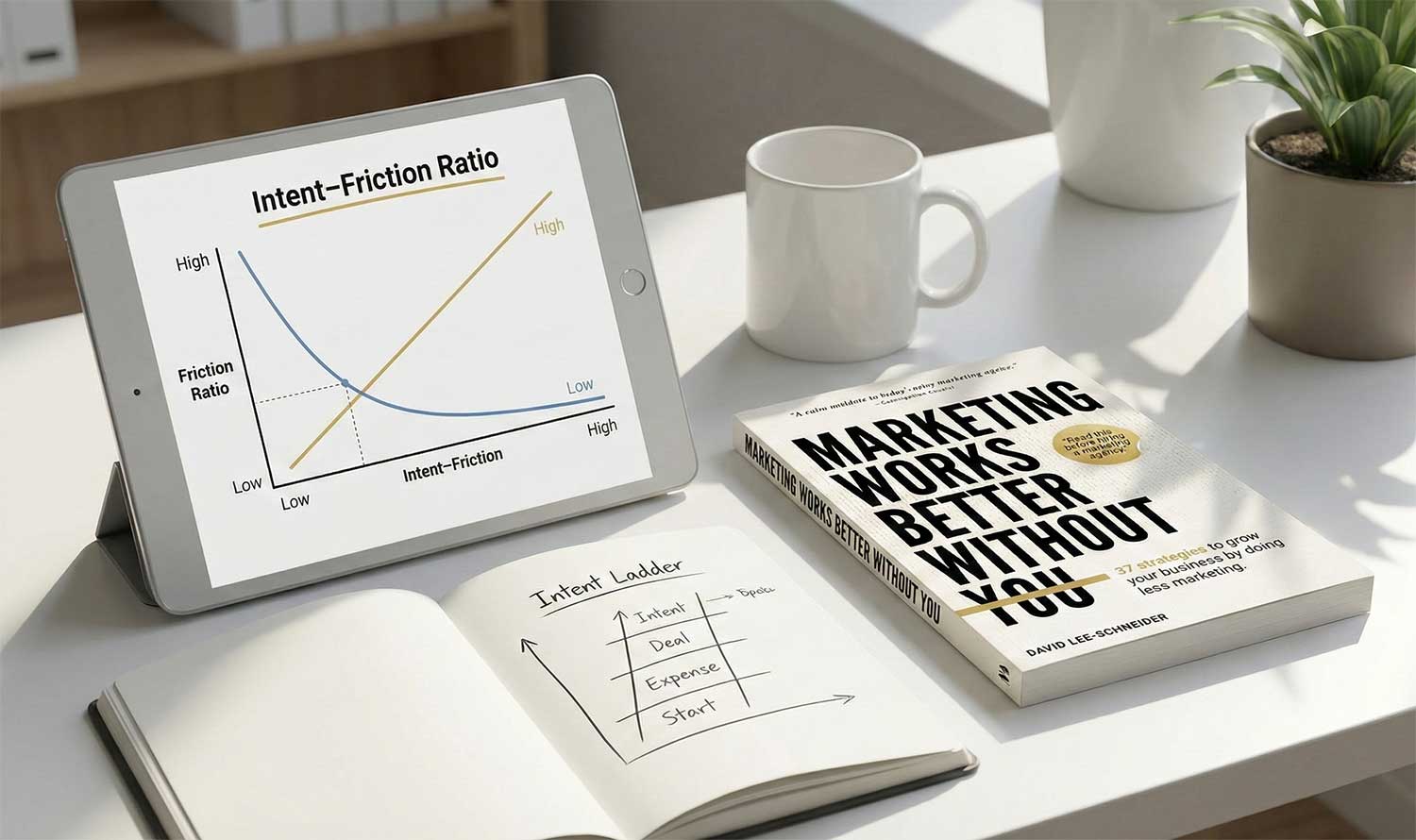
I first introduced the intent-friction ratio in my book Marketing Works Better Without You, after seeing the same conversion pattern repeat across hundreds of websites.

What the intent-friction ratio means

Every visitor arrives with a certain level of intent. That intent might be vague curiosity or it might be a clear readiness to act.

At the same time, every website introduces friction. Friction is the effort required to move forward.

  • Pages to navigate
  • Forms to fill out.
  • Decisions to make.
  • Language to interpret.
  • Uncertainty to resolve.

The intent-friction ratio is simply the relationship between those two forces.

When motivation is high and effort is low, conversion feels easy.

When motivation is high and effort is high, people stall or disappear.

When motivation is low and effort is low, people may stay engaged.

When motivation is low and effort is high, nothing happens.

Most conversion problems come from a mismatch, not from a lack of interest.
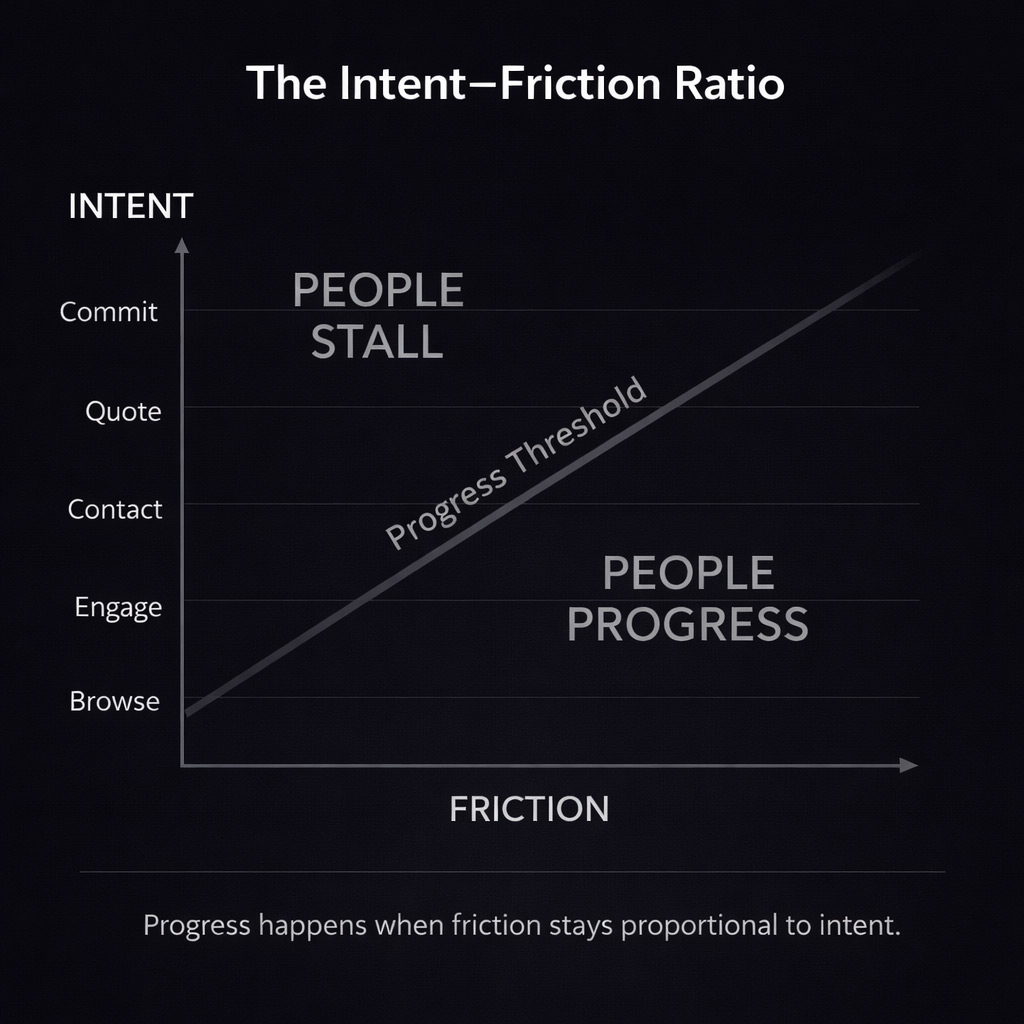

The Intent-Friction Ratio: Conversion Is a Balance Between Motivation and Effort


The intent ladder

To understand the ratio, it helps to understand intent itself.

Not everyone arrives in the same state of mind.

  • Some people are exploring.
  • Some are comparing.
  • Some are ready to move.

You can think of this as an intent ladder.

At the top, intent is low. People are learning and orienting themselves.

In the middle, intent is forming. People are evaluating options.

At the bottom, intent is high. People want to take a next step.

The mistake most websites make is treating everyone the same, regardless of where they are on that ladder.

Why friction is not always bad

Friction gets a bad reputation, but friction is not the enemy.

Friction is only a problem when it is out of proportion to intent.

A detailed enquiry form can be perfectly reasonable for someone who is ready to engage. The same form feels exhausting to someone who is just trying to understand a problem.

The issue is not how much friction exists.

The issue is when and where it appears.

Practical example one. Contact forms

Someone searches for “web designer near me”.

That is a strong signal of intent.

If they land on a page with a short, clear form that asks only what is needed to start a conversation, the ratio feels right.

If they are asked for budgets, timelines, internal approvals, marketing goals and long explanations before they have spoken to a human, the ratio breaks.

Their motivation was high, but the effort demanded even more.

Now compare that with someone reading an article about why websites struggle to convert.

That person is early stage.

A light next step like a short email sign up makes sense. A full contact form does not.

Same form. Different intent. Very different outcome.

Practical example two. Service pages

Many service pages try to do everything at once.

  • They educate.
  • They sell.
  • They qualify.
  • They reassure.
  • They close.

This creates friction because the page is unclear about who it is for.

A high intent service page should prioritise clarity, reassurance and direction. Not long explanations.

An early stage page should reduce pressure and offer a way to continue without commitment.

One page. One dominant intent level.

Practical example three. Pricing pages

Pricing pages are one of the clearest signals of elevated intent.

If someone clicks on pricing, they are already leaning forward.

Hiding prices behind calls or forcing people through long explanations adds friction at exactly the wrong moment.

The job of a pricing page is not to persuade someone that pricing exists. It is to help them decide whether it fits.

How to use the intent-friction ratio

You do not need more tactics. You need better alignment.

For every page on your site, ask one question.

What level of intent does someone have when they land here?

Then ask a second.

Does the effort I am asking for match that intent?

If those two are out of sync, conversion will always feel harder than it should.

Why this matters

When you design with the intent-friction ratio in mind, something shifts.

  • You stop pushing people who are not ready.
  • You stop slowing down people who are.
  • You remove obstacles instead of adding persuasion.

Marketing becomes quieter, simpler and more effective.

In my experience, that is where the real gains usually are.

Recently, I had a conversation with the owner of a beauty salon in Sydney who asked me for the best ways to market her business. But when I mentioned email marketing as a strategy, she looked at me stunned. “Aren’t emails dead?”, she asked.

The answer is, far from it! To this day, email marketing remains one of the most effective (and profitable) ways to reach your target audience. In fact, it’s never been more important for small business owners to focus on building their email marketing list than in 2026. Here are 5 reasons why.

1. You Own The Data And Stay in Control

Many business owners are under the impression that a Facebook or Instagram page is enough nowadays as a marketing strategy. And while I agree that they provide a fantastic opportunity to grow your audience, no business should solely rely on social media.

Facebook has already made drastic changes to the way your content is distributed. Have you noticed that your reach has decreased significantly over the last few years? Even if your page has thousands of followers, that doesn’t mean you can reach them. Only about 5-10% will actually see your posts.

The reason is that Facebook and Instagram are in the business of advertising. So, if you operate a business page, of course they want you to pay for your content to reach more people. That means it’s really out of your control.

As a business owner, you always want to minimise risks and putting too much power in the hand of social media companies is a risky move. Your email list, however, is completely owned by you, not Meta.

2. Email Marketing Delivers Personalised Experiences

One of the biggest benefits of email marketing is that it allows you to create personalised customer journeys. When you send an email to your list, you’re not just reaching out to everyone on that list – you’re targeting each contact personally. This means that you can connect with your customers on a more personal level, creating a stronger connection and building trust.

Think about it this way: If a business sends you an email and all they say is, “Hey, thanks for subscribing!” – chances are that you find it rather impersonal. But if they send you an email that’s personalised and tailored specifically to your interests, then you’re much more likely to read and respond.

Especially in small businesses, this can have a huge effect on how their business is perceived. Making use of email automation is very much like cloning yourself multiple times. You can send all your leads and customers the right message at the right time. And in marketing, timing is everything.


Get the Book: Marketing Works Better Without You: 37 Strategies to Grow Your Business by Doing Less


3. Email Marketing Allows You to Build Long-Term Relationships with Customers

Another great benefit of email marketing is that it can be used to establish long-term relationships with your customers. This builds trust and keeps your customers coming back – which is essential for small businesses on a budget.

Email is the ideal medium to onboard new customers using a series of short messages to introduce them to your services, your team and all the other benefits your business provides. It’s also a great way to introduce existing customers to products and services they haven’t tried before. This will also increase your chances of building repeat business and increasing your overall sales.

Do you know your Digital Marketing Score? Take this short quiz to find out and receive practical, actionable tips to increase leads, sales and profitability. It’s absolutely free!

4. Email Marketing Can Be Used To Drive Traffic To Your Website (Or Wherever You Want It)

One of the best ways to drive traffic to your website is through email marketing. Having people join your mailing list, means you can reach out to them again and again at virtually no cost. This means that you can send them new content and updates regularly, driving traffic back to your website, to specific offers, to your other social media channels and more.

Moreover, it allows you to invite customers to leave a review for your business on Google and Facebook, which is a fantastic way to enhance your reputation online and improve your Google rankings.

With all these benefits, email marketing should no longer be an option, but an absolute must-have for any small business owner who is serious about growing their business.

5. Your Email Marketing Strategy Can Be Fully Automated

To me, the real benefit of implementing an email marketing strategy is that it can be completely automated. That means it’s not another thing you, as the business owner, have to manage or worry about. It’s something you can set and forget, like we did for V-Hub Dance, a dance studio based in Brisbane, Australia.

Marketing automation is often overlooked and undervalued.

As a marketing consultant, I help business owners all over Australia implement effective, fully automated marketing strategies that free up their time, budget and headspace.

If you would like to have a chat about your business and how we can use email marketing and other automation tools to help you scale, click here to book a free strategy call with me today.