

Most websites do not have a traffic problem.
They have a structure problem.
Specifically, they do not have proper service pages.
Instead of dedicated pages for individual services, many websites rely on a single generic services page. It lists everything the business offers, often in neat sections or tiles, and assumes the visitor will work out what applies to them.
From the business side, this feels efficient.
From the buyer side, it creates friction.
When someone searches for a specific service and lands on a page that talks about five or ten different offerings, the mental effort increases immediately. The visitor is forced to filter, interpret, and self-navigate at the exact moment they were hoping for clarity.
This is where intent quietly leaks away.
Why Dedicated Service Pages Matter
Dedicated service pages exist for one reason.
They reduce thinking.
When someone clicks through from a search result, an ad, or a referral, they are not browsing. They are checking alignment. They want to know whether this service is for them, whether the business understands their situation, and whether taking the next step will be straightforward.
A single generic services page cannot do that well. It has too many jobs.
Dedicated pages remove that burden.
Each page speaks to one problem.
One intent.
One decision.
This is why businesses with fewer services, but clearer pages, often outperform those with broader offerings. The visitor does not need to decode relevance. It is immediately obvious.
However, even when businesses create dedicated service pages, most still underperform.
Not because the pages are missing information, but because they are structured incorrectly.
Where Most Service Pages Go Wrong
Once a business commits to dedicated service pages, the instinct is to explain.
What the service includes.
How the process works.
Why the business is different.
What packages are available.
The page becomes thorough, well written, and logically organised.
And still, conversion stalls.
Across hundreds of service pages reviewed over time, the same pattern appears. Visitors arrive with clear intent, scroll with interest, and then slow down. Not because they doubt the service, but because the page increases effort at the wrong moment.
This is the gap the Mirror Bridge Relief framework addresses.
What the Mirror Bridge Relief Framework Describes
Mirror Bridge Relief, often shortened to MBR, is a framework for structuring service pages where intent already exists.
It does not aim to create desire. It assumes desire is present.
It focuses on reducing friction at the moment of decision.
The framework has three stages.
Mirror
Bridge
Relief
Each stage corresponds to a specific mental state the visitor moves through when deciding whether to take the next step.
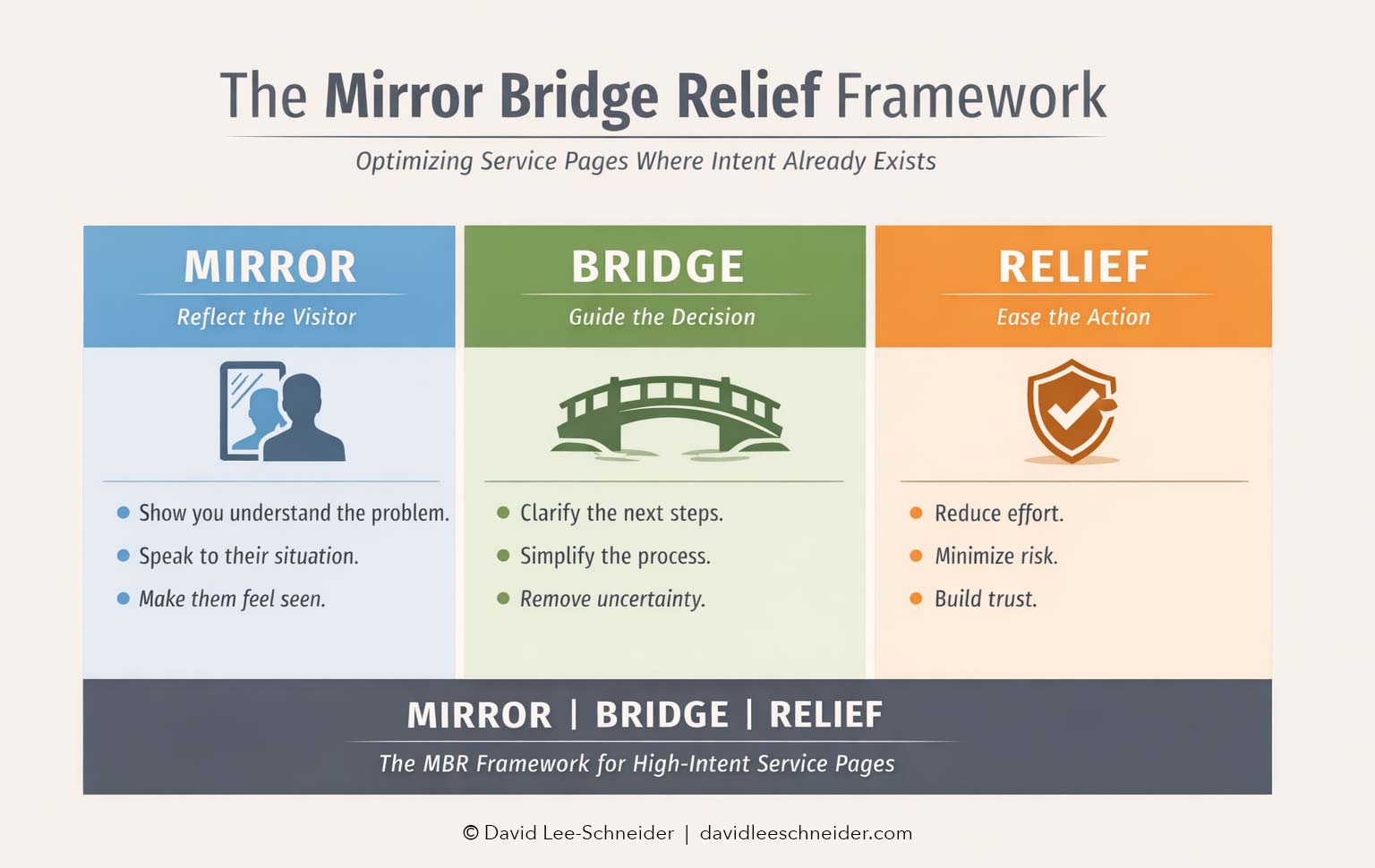
The Mirror Bridge Relief Framework: A Practical Model for High-Intent Service Pages
Mirror: Recognition Before Explanation
The Mirror stage exists to answer one question.
Is this for someone like me
Rather than leading with services, credentials, or claims, the page reflects the visitor’s situation back to them. It names the problem they already recognise. It acknowledges the context they are operating in.
When the Mirror works, the visitor does not feel persuaded. They feel understood.
This moment of recognition is what earns attention for everything that follows.
Bridge: Orientation Without Overload
Once recognition is established, the visitor needs orientation.
The Bridge answers the question.
What happens from here
This is where structure matters more than detail.
The Bridge explains the service at a high level, clarifies who it is suited for, and removes ambiguity about the path forward. It does not overwhelm with process diagrams or specifications. It creates a sense of direction.
A strong Bridge reduces cognitive load. It replaces uncertainty with clarity.
Relief: Making the Next Step Feel Easy
Relief addresses the final source of friction.
The perceived cost of action.
People rarely leave because they are unconvinced. They leave because the next step feels heavy.
Too many fields.
Too much commitment.
Too many unknowns.
Relief reduces that weight.
Clear calls to action.
Minimal forms.
Reassurance about what happens after contact.
Signals of safety and control.
When Relief is done well, taking action feels easier than continuing to evaluate.
Why The MBR Framework Works for Service Pages
Traditional copywriting frameworks focus on persuasion and motivation.
Service pages operate in a different context.
The visitor is already interested. The role of the page is not to convince them the problem exists, but to make moving forward feel simple and safe.
Mirror Bridge Relief is designed specifically for that context.
It removes friction instead of adding pressure.
Where MBR Is Best Applied
MBR works best on pages where intent is high and decisions matter.
Dedicated service pages
Consultation and audit pages
High-intent landing pages
Offer explanation pages
It is not intended for cold traffic or awareness content. It is designed for moments where the visitor is already leaning in.
AIDA vs PAS vs MBR – When to Use Which Copywriting Framework
| Situation | AIDA | PAS | MBR |
|---|---|---|---|
| Cold traffic ads | Strong fit | Good fit | Not ideal |
| Low problem awareness | Good fit | Excellent fit | Poor fit |
| High problem awareness | Moderate fit | Good fit | Strong fit |
| Service pages | Weak fit | Moderate fit | Excellent fit |
| Consultation or audit pages | Weak fit | Moderate fit | Excellent fit |
| High-trust decisions | Weak fit | Moderate fit | Excellent fit |
| Emotionally aware audience | Increasing resistance | Risk of pushback | Strong alignment |
| Short-form persuasion | Excellent | Good | Moderate |
| Reducing friction at decision point | Weak | Weak | Core strength |
| Buyers sensitive to manipulation | Risky | Often rejected | Designed for this |
Most businesses do not need more traffic.
They need less friction between interest and action.
Dedicated service pages create the right environment.
Mirror Bridge Relief provides the structure.
When both are in place, service pages stop trying to persuade and start making decisions easier.
If this article was useful, the book goes further. Marketing Works Better Without You shows how to build marketing that keeps working without constant posting, pushing, or chasing. It focuses on reducing friction, attracting higher-intent enquiries, and letting your website do more of the work for you. Read more about the book here.
 David Lee-Schneider Marketing